Social media marketing can help businesses build brand awareness, connect with customers, generate leads and drive sales. But simply creating profiles on Instagram, Facebook, LinkedIn or other platforms and posting regularly is not a complete social media marketing strategy.
Before investing your time and budget in social media marketing, it is important to understand what you want to achieve, who you want to reach, what content you should create and how you will measure success.
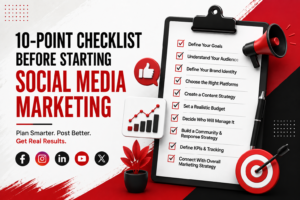
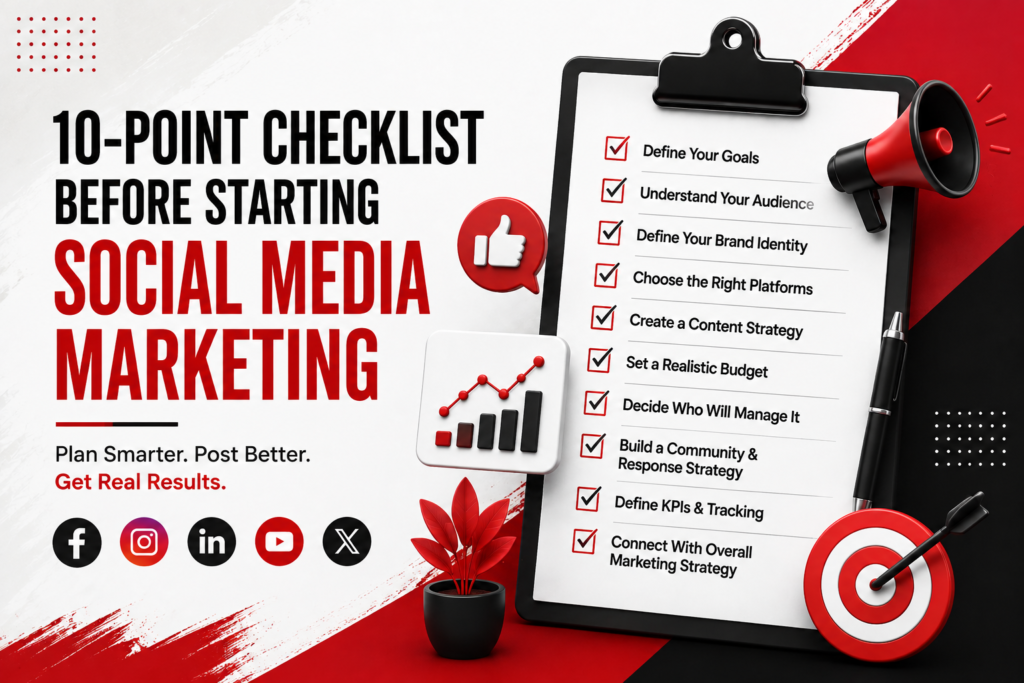
Whether you are planning to manage social media in-house, hire a freelancer or work with a digital marketing agency, this 10-point checklist can help you prepare a stronger social media marketing strategy.
1. Define Your Social Media Marketing Goals
The first step is to decide why your business needs social media marketing.
Different businesses can have different objectives. For example:
- Increasing brand awareness
- Generating qualified leads
- Increasing website traffic
- Driving online sales
- Building a community
- Improving customer engagement
- Promoting products, services or events
- Establishing industry authority
Your goals should be specific and measurable. Instead of saying, “We want more engagement,” define what success means for your business.
For example, a B2B company may focus on qualified leads, while an ecommerce brand may focus on purchases and return on ad spend (ROAS).
A clear objective makes it easier to choose the right platforms, content formats and advertising strategy.
2. Understand Your Target Audience
Successful social media marketing starts with understanding the people you want to reach.
Before creating content, identify:
- Who are your ideal customers?
- Where are they located?
- What problems are they trying to solve?
- What products or services are they looking for?
- What type of content do they consume?
- Which social media platforms do they use?
- What factors influence their purchasing decisions?
For example, a local service business may need a different strategy from a B2B software company or an ecommerce fashion brand.
The better you understand your audience, the easier it becomes to create content that is relevant, useful and engaging.
3. Define Your Brand Identity
Your social media profiles should look and feel like the same brand.
Before starting your campaigns, establish basic brand guidelines covering:
- Logo usage
- Brand colours
- Fonts
- Visual style
- Tone of voice
- Content style
- Key brand messages
- Image and video guidelines
Consistency helps customers recognize your business across different platforms.
For example, if your business positions itself as professional and premium, your graphics, captions, videos and customer communication should support that positioning.
Social media should not be treated as a collection of random posts. Every piece of content should contribute to your overall brand identity.
4. Choose the Right Social Media Platforms
You do not need to be active on every social media platform.
The right platform depends on your audience, business model, content capabilities and marketing objectives.
For example:
Instagram can be useful for visual brands, lifestyle businesses, creators and ecommerce companies.
Facebook can be valuable for local businesses, communities, customer engagement and reaching broad audiences.
LinkedIn is particularly relevant for B2B companies, professional services, recruitment and industry-focused communication.
YouTube can be effective when your marketing strategy depends heavily on educational, demonstration or long-form video content.
The goal is not to maintain the maximum number of social profiles. The goal is to build a meaningful presence on the platforms that can contribute to your business objectives.
5. Create a Content Strategy Before You Start Posting
One of the biggest mistakes businesses make is deciding what to post only when it is time to publish.
Instead, create a content strategy in advance.
Your content mix can include:
- Educational content
- Product or service information
- Customer testimonials
- Case studies
- Frequently asked questions
- Industry insights
- Behind-the-scenes content
- Short-form videos and Reels
- Company updates
- Offers and promotions
- User-generated content
- Founder or team content
Your content should not be promotional all the time.
A good strategy balances education, engagement, trust-building and promotion.
Create a content calendar that defines what will be published, on which platform, in what format and for what objective.
6. Set a Realistic Social Media Marketing Budget
Although creating a social media account is generally free, professional social media marketing requires resources.
Your overall budget may include:
- Social media management
- Graphic design
- Video production
- Copywriting
- Paid social media advertising
- Influencer or creator collaborations
- Marketing tools
- Analytics and reporting
It is also important to understand the difference between social media management fees and advertising spend.
For example, if you hire an agency to manage your social media accounts, the agency’s management fee and the budget you spend on Meta or other advertising platforms may be separate.
Set your budget according to your business goals and expected return rather than simply choosing the cheapest available option.
7. Decide Who Will Manage Your Social Media
Social media marketing involves much more than publishing posts.
Someone needs to handle:
- Content planning
- Copywriting
- Graphic and video creation
- Publishing
- Community management
- Comment and message responses
- Paid advertising
- Performance monitoring
- Reporting
- Strategy improvements
You can manage these activities through an in-house team, freelancer or digital marketing agency.
If you plan to outsource social media marketing, evaluate the service provider based on their experience, previous work, reporting process, communication system, advertising expertise and understanding of your industry. A good social media partner should be able to explain why a particular strategy is being recommended—not just how many posts will be published every month.
8. Prepare a Community and Customer Response Strategy
Social media is a two-way communication channel.
Posting content is only one part of the job. Your business also needs to respond to comments, direct messages, questions, reviews and complaints.
Before launching your social media campaign, establish guidelines for:
- Response time
- Customer queries
- Negative comments
- Complaints
- Product or service questions
- Lead enquiries
- Escalation of serious issues
- Brand tone during conversations
A quick and professional response can improve customer experience and build trust.
On the other hand, ignoring genuine customer questions or responding poorly to complaints can negatively affect your brand reputation.
9. Define Your KPIs and Tracking System
Not every social media metric is equally important.
The right Key Performance Indicators (KPIs) depend on your business objective.
For example:
For brand awareness:
- Reach
- Impressions
- Video views
- Follower growth
For engagement:
- Comments
- Shares
- Saves
- Engagement rate
For lead generation:
- Number of leads
- Cost per lead
- Lead quality
- Landing page conversion rate
For ecommerce:
- Purchases
- Cost per acquisition
- Conversion rate
- Revenue
- ROAS
Likes and followers can be useful indicators, but they should not be treated as the only measure of marketing success.
Whenever possible, connect social media activity with your website analytics, lead tracking and sales data so you can understand whether your marketing is contributing to actual business results.
10. Connect Social Media With Your Overall Digital Marketing Strategy
Social media should not operate in isolation.
Your social media strategy can work together with:
- Website and landing pages
- Search Engine Optimization (SEO)
- Google Ads
- Email marketing
- WhatsApp marketing
- Content marketing
- Online reputation management
- Public relations
- Offline campaigns
For example, a social media campaign can drive users to a dedicated landing page, while retargeting campaigns can reach people who previously interacted with your website or content.
Similarly, useful content created for social media can sometimes be repurposed for blogs, videos, email campaigns and other marketing channels.
An integrated strategy can make your overall digital marketing efforts more consistent and measurable.
Common Social Media Marketing Mistakes to Avoid
Before starting your campaign, avoid these common mistakes:
- Creating accounts on every platform without a clear purpose
- Posting without a content strategy
- Focusing only on promotional content
- Buying followers or engagement
- Ignoring comments and messages
- Measuring success only through likes and followers
- Running paid campaigns without proper tracking
- Using the same content everywhere without adapting it to each platform
- Changing strategy too frequently without giving campaigns enough time to generate meaningful data
- Treating social media as a standalone activity instead of part of the overall marketing strategy
Final Thoughts
Social media marketing can become a valuable growth channel when it is backed by a clear strategy, relevant content, consistent branding, proper audience targeting and meaningful performance measurement.
Before you start, make sure you know what you want to achieve, who you want to reach, where you should reach them and how you will measure the results.
The objective should not simply be to “post more.” The objective should be to use social media to create awareness, build trust, generate meaningful engagement and ultimately contribute to your business growth.
Looking for Professional Social Media Marketing Support?
If you want to build a consistent social media presence without managing everything in-house, WebClixs can help with social media strategy, content planning, creative management, social media advertising, lead generation and performance tracking.
Whether your objective is brand awareness, customer engagement or lead generation, the right strategy can help you turn social media activity into measurable business outcomes.
Get in touch with WebClixs to discuss your social media marketing goals.