An Expert Opinion
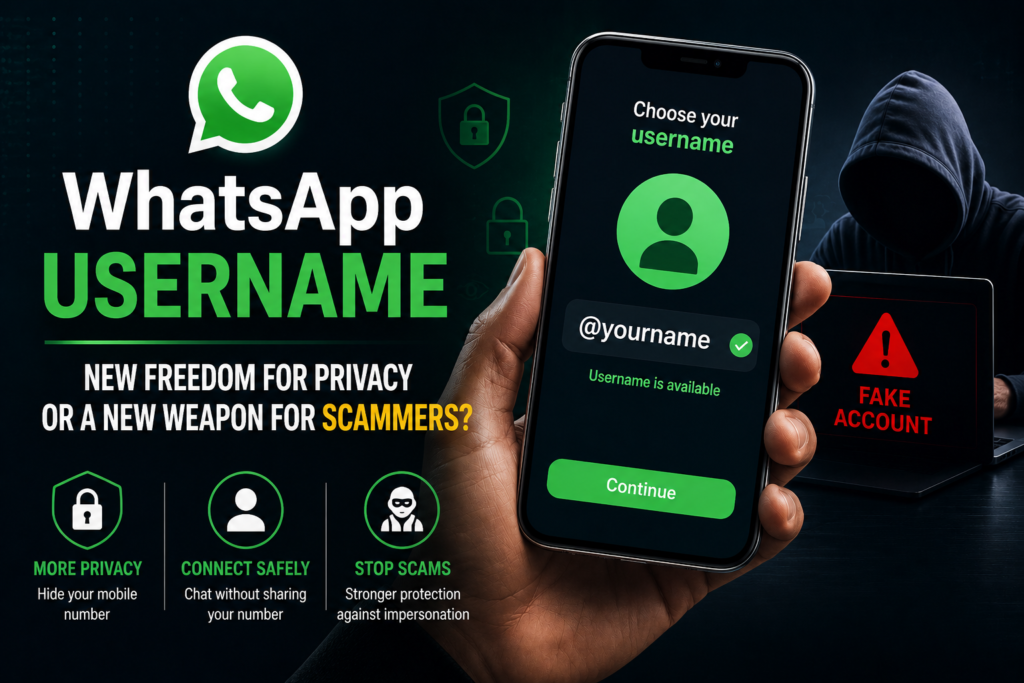
With nearly 3 billion users worldwide, WhatsApp’s upcoming Username Feature has quickly become one of the most talked-about developments in the tech world. The idea is simple: users will no longer have to share their phone numbers to connect with others. At first glance, it sounds like a long-overdue privacy upgrade.
After all, who enjoys sharing their number with a local business only to receive endless calls offering premium credit cards, miracle investments, or “exclusive” insurance plans the very next day?
On paper, WhatsApp’s new feature is designed to solve a genuine privacy problem. But in a country where cyber fraud evolves almost as quickly as technology itself, one important question deserves attention:
Will usernames protect users – or simply make scammers more creative?
What Exactly Is the WhatsApp Username Feature?
Privacy is valuable – but privacy without strong security can become a cybercriminal’s opportunity.
Until now, connecting with someone on WhatsApp required exchanging phone numbers. The new Username Feature aims to change that.
Users will be able to create a unique username that others can use to find and message them without revealing their personal phone number.
For freelancers, journalists, doctors, lawyers, creators, entrepreneurs, online sellers, and professionals who regularly interact with strangers, this could be a significant privacy improvement. It separates personal contact information from public communication – a feature users have wanted for years.
So far, so good.
Then Why Is It Raising Concerns?
Because every new technology attracts two groups before anyone else: ordinary users and cybercriminals. The difference lies in what they see.
An ordinary user thinks,
“That’s a useful new feature.”
A scammer thinks,
“That’s a promising new business opportunity.”
While the world is busy researching Artificial Intelligence, cybercriminals are busy researching human behavior.
They already know that adding a national flag to a profile picture, using words like “Official” or “Support,” and writing a few professional-looking lines are often enough to earn a stranger’s trust.
Now imagine giving them usernames as well.
One can almost hear their marketing department celebrating.
The Government’s Concerns Are Understandable
Governments are expected to ask difficult questions-especially when digital fraud is growing at an alarming pace.
Over the last few years, people have witnessed a surge in investment scams, fake customer support, impersonation, banking fraud, and the now infamous “digital arrest” scams.
A username like @BankSupport, @IncomeTaxHelp, or @PoliceIndiaOfficial could easily confuse unsuspecting users if adequate safeguards are not in place.
The concern is not the technology itself.
The concern is how convincingly it can be misused.
Meta Isn’t Wrong Either
Meta maintains that usernames are about privacy-not anonymity.
Accounts will still be linked to verified phone numbers behind the scenes. According to the company, it plans to introduce multiple safeguards to prevent impersonation, abuse, and fraudulent usernames.
If implemented effectively, these protections could make WhatsApp significantly safer for millions of users who simply want to communicate without exposing their personal numbers.
That is a genuine benefit.
The real challenge is whether these protections can work consistently across billions of users and millions of daily interactions.
The Phone Number May Be Hidden. Human Intentions Won’t.
This is where the debate becomes interesting.
WhatsApp argues that usernames improve privacy.
That’s true.
But India’s biggest cybersecurity challenge has never been phone numbers.
It has always been the person sitting behind the screen.
If someone creates a username that resembles a government department, a bank, a celebrity, or a trusted institution, many users won’t stop to verify it.
Some will say “Hello.”
Some will reply with “Hi Sir.”
And unfortunately, a few may share sensitive information before realizing they are talking to a scammer.
Technology rarely creates fraud.
It simply gives fraudsters new tools.
Should the Feature Be Banned?
Probably not.
Banning innovation has never been a sustainable solution.
Making innovation safer is.
Rather than turning this into a battle between regulators and technology companies, both sides should work toward responsible implementation.
That includes:
- Reserving usernames for government departments, public institutions, and well-known personalities.
- Introducing a strong verification system for authentic accounts.
- Limiting how frequently usernames can be changed.
- Restricting messaging activity from newly created accounts.
- Making suspicious usernames easier to report and remove.
- Investing in nationwide cybersecurity awareness campaigns – starting with schools, where young users are becoming digitally active long before they fully understand online risks.
Technology alone cannot solve cybersecurity. Digital awareness remains the strongest defense
Trust Less. Verify More.
Perhaps the biggest lesson is also the simplest.
Just because an account says “Official” doesn’t mean it is.
The internet has made verification easier than ever.
Ironically, it has also made blind trust easier than ever.
The responsibility, therefore, doesn’t belong only to Meta or the government.
It belongs to every user.
Final Thoughts
WhatsApp’s Username Feature has the potential to become one of the platform’s most meaningful privacy upgrades in years.
It could help professionals protect their personal information, reduce unnecessary exposure of phone numbers, and make digital communication more secure.
But privacy without trust is incomplete.
And trust without verification is dangerous.
In India, technology rarely arrives alone. It is usually followed by innovation, improvisation… and unfortunately, a few people looking for ways to exploit it.
Whether WhatsApp Username becomes a breakthrough for digital privacy or another opportunity for cybercriminals will depend not only on Meta’s security measures but also on how responsibly users embrace the feature.
Because in cybersecurity,
The weakest link in cybersecurity has never been technology. It has always been human judgment.
In This WebClixs Expert Analysis
This article explores both sides of WhatsApp’s upcoming Username Feature – from its privacy advantages to the cybersecurity risks it may introduce. Here’s what you’ll learn:
✔ How WhatsApp Username works
✔ Why governments are paying attention
✔ The biggest risks for everyday users
✔ Meta’s security measures
✔ Expert recommendations for staying safe
✔ Final verdict: Privacy breakthrough or cybercrime opportunity?
Frequently Asked Questions
What is the WhatsApp Username Feature?
The WhatsApp Username Feature lets users connect without sharing their phone numbers. Instead, people can use a unique username to start conversations while keeping personal contact details private.
How does WhatsApp Username improve privacy?
It hides your mobile number from people you chat with, making it easier to communicate securely without exposing your personal contact information.
Can scammers misuse WhatsApp usernames?
Yes. Fake usernames that resemble trusted brands or organizations could be used for impersonation scams. Always verify an account before trusting it.
Will my phone number remain hidden?
Yes. Your phone number stays private during chats, although it remains linked to your WhatsApp account for security and verification purposes.
Is the WhatsApp Username Feature safe?
Yes, if supported by strong security measures and responsible user behavior. Always verify unknown accounts and avoid sharing sensitive information without confirmation.
Is WhatsApp Username available in India?
The feature is expected to roll out gradually. Availability may vary depending on your app version and WhatsApp’s phased rollout.