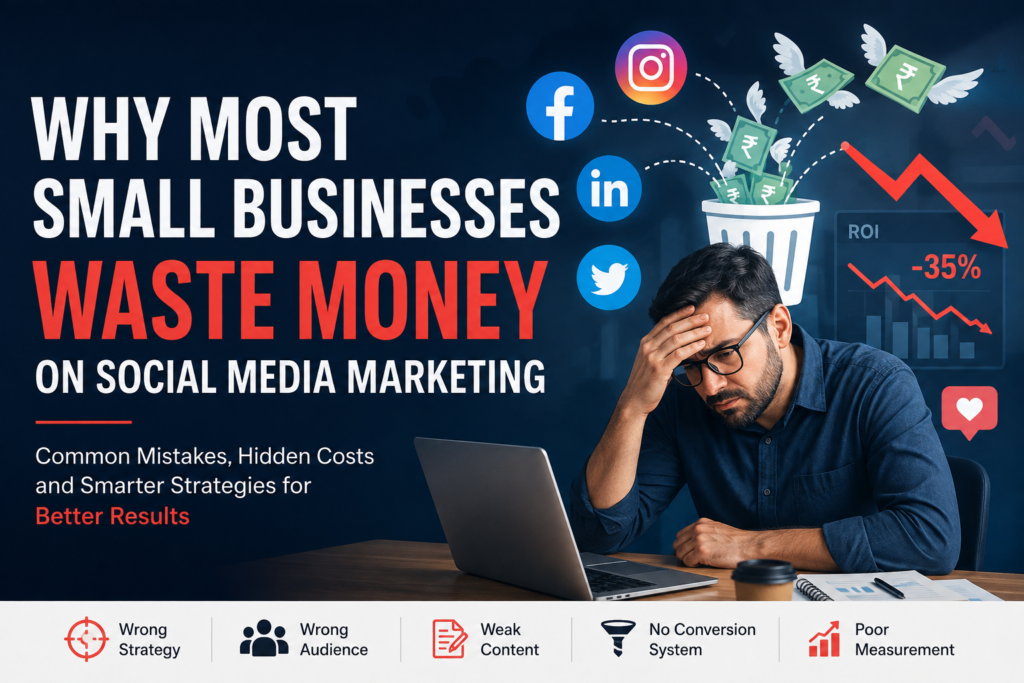
Social media marketing has become an essential part of modern business. Yet many small businesses spend money on Facebook, Instagram, LinkedIn, and other platforms without seeing enough leads or sales.
The problem is usually not social media itself. The real problem is using social media without a clear strategy.
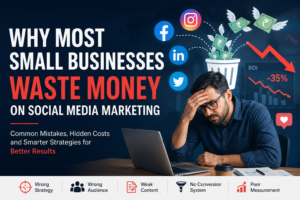
Here are the most common reasons small businesses waste money on social media marketing.
1. Trying to Be Everywhere
Many businesses try to maintain a presence on every platform. But your customers may not be active everywhere.
A local restaurant may benefit more from Instagram and WhatsApp, while a B2B company may get better results from LinkedIn.
You don’t need to be everywhere. You need to be where your customers are.
2. Confusing Followers with Business Growth
A large follower count looks impressive, but followers don’t automatically generate revenue.
Instead of focusing only on likes and followers, track:
- Qualified leads
- Enquiries
- Website visits
- Sales
- Cost per lead
- Customer acquisition cost
- Revenue generated
A campaign with 5,000 views and 20 qualified leads can be more valuable than one with 100,000 views and no enquiries.
3. Spending Too Much on Beautiful Posts
Good design helps build a professional brand, but attractive graphics alone don’t generate sales.
If every post simply says “We provide the best services” or “Contact us today,” there is little reason for people to engage.
Effective content should educate, solve problems, demonstrate expertise, build trust, or provide useful information.
Design matters, but value matters more.
4. Creating Content Without a Conversion System
Imagine a Reel gets 20,000 views. What happens next?
If your profile has no clear offer, your website is confusing, and customers cannot easily contact you, those views may generate very little business.
A better customer journey is:
Content → Profile → Website/WhatsApp → Enquiry → Follow-up → Sale
Social media is often only the beginning of the customer journey.
5. Expecting Every Post to Generate a Sale
Not every customer buys immediately.
Someone may discover your business today, visit your profile next week, check your website later, and contact you several weeks afterward.
Social media therefore supports different stages:
Awareness → Trust → Consideration → Conversion
Your content should reflect all these stages instead of trying to sell something in every post.
6. Running Ads Without Testing
Simply putting money behind a post and hoping for results is not a strategy.
Paid campaigns need testing across:
- Audience
- Creative
- Offer
- Copy
- Call-to-action
- Landing page
If an ad performs poorly, the problem may be the targeting, creative, offer, or conversion process—not necessarily the platform.
7. Using AI Without a Human Perspective
AI can make content creation faster, but completely generic AI-generated content can make every brand sound the same.
Use AI for research, ideas, and efficiency—but add your real experience, opinions, examples, and expertise.
That human perspective is what makes content valuable and memorable.
8. Measuring the Wrong Results
Instead of asking:
“How many followers did we gain?”
ask:
“What business value did social media generate?”
Track leads, conversions, revenue, cost per lead, customer acquisition cost, and ROAS where applicable.
What Should Small Businesses Do?
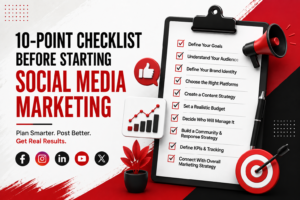
A better social media marketing strategy starts with a few simple steps:
1. Define one clear goal — awareness, leads, sales, or retention.
2. Choose the right platforms — focus on where your customers are.
3. Create useful content — educate, solve problems, demonstrate expertise, and build trust.
4. Make the next step clear — website, WhatsApp, enquiry, booking, or purchase.
5. Track results — measure business outcomes, not just engagement.
6. Scale what works — invest more in the content, audience, and campaigns that produce results.
The Real Problem Isn’t Social Media
Small businesses don’t waste money because social media doesn’t work. They waste money when they create content without a strategy, run ads without testing, and measure activity instead of business results.
Social media is now part of the customer journey—from discovery and trust to conversation and purchase.
The question isn’t:
“How much should we spend on social media?”
The better question is:
“How can social media contribute to our business growth?”
When content, targeting, offers, conversion systems, and measurement work together, social media becomes more than a marketing expense- it becomes a business growth investment.
WebClixs Insight: Small businesses don’t necessarily need more content. They need better strategy, better targeting, better measurement, and better conversion systems.